Insurance & Storm Damage
Scottsdale monsoon roof prep: what the season actually does to Valley roofs and how to be ready
Scottsdale monsoon season runs mid-June through mid-September. The damage isn't from the rain; it's from 50 to 80 mph straight-line winds lifting tile and tearing ridge cap. Here's what to do before, during, and after.

TL;DR
The quick version
- Scottsdale monsoon season runs June 15 through September 30; peak storm activity is mid-July to mid-August with cells arriving between 5 PM and 8 PM.
- The damage is wind, not rain. 50 to 80 mph straight-line microburst winds lift tile, tear ridge cap, and expose the underlayment beneath.
- North Scottsdale (85255, 85262, 85266) sees the largest Valley hail events and strongest microbursts; communities affected include DC Ranch, Silverleaf, Troon, Desert Mountain, Estancia.
- Pre-monsoon prep ($300 to $1,200 in targeted repairs) almost always prevents $3,000 to $15,000 in post-storm work. The window to schedule is May through early June, before the first cell arrives.
- If your roof is past 15 years old, schedule a paid inspection now ($150 to $275, credited toward any work). Catches the specific weak points the first major storm will exploit.
Scottsdale's monsoon season runs from roughly mid-June through mid-September, and the storms that pass through every summer are the single biggest cause of mid-life roof failures we see across the Valley. If you live in Scottsdale and you're reading this in June, July, August, or early September, the next storm cell is probably within two weeks. This is the time to know what your roof is set up to handle and what it isn't.
I've watched a lot of Scottsdale monsoons come through over the years, and the pattern is more predictable than people think. Cells build over the high country to the east in the late afternoon, drop down into the Valley between 4 PM and 9 PM, and pass through in 30 to 90 minutes with straight-line winds of 50 to 80 mph and brief but heavy rain. The roof damage isn't from the rain. It's from the wind lifting tile, tearing ridge cap, and exposing the underlayment beneath.
This guide walks through what Scottsdale monsoons actually do to roofs, the patterns we see by ZIP code, what to do before storms hit, what to watch for during them, and what to do in the 48 hours after. None of this is meant to scare anyone. It's the operational reality of owning a roof in the desert in summer, and a homeowner who knows what to expect handles the season noticeably better than one who doesn't.
If you're reading this in late September or later, the prep sections below are next year's work. Skip to the post-season section at the end: this summer's storms have already done whatever they were going to do, and the useful question now is whether your roof took damage you haven't found yet.
Why Scottsdale monsoons hit roofs harder than people expect
The biggest misconception about Arizona summer storms is that the danger is the rain volume. It isn't, not for roofs. Phoenix Valley monsoons drop one to three inches of rain in 30 to 60 minutes during a typical event. That's enough to overwhelm gutters and cause yard flooding, but it doesn't itself damage roofs.
The real damage comes from three other forces.
Straight-line winds. Monsoon microbursts produce sustained winds of 50 to 70 mph with gusts up to 100 mph in the strongest cells. These are not the rotating winds of a tornado. They're a wall of air pushing horizontally across the roof. Tile that was loosely set or has lost its mortar bed lifts. Ridge cap that was bedded with weakened mortar tears off. Shingle tabs that have lost their adhesive bond at the seal strip pull free.
Hail. Less frequent than the Midwest but heavier and more concentrated when it hits. North Scottsdale (85255, 85262, 85266) sees the largest Valley hail events because of the topography. Hail on concrete tile shows as cracking, often on the north-facing slope where the impact angle is direct. On asphalt shingle it shows as round bruise marks where the granules have been knocked off.
Wind-driven debris. Loose patio furniture, palm fronds, pool noodles, kids' toys, and anything else not tied down becomes a projectile. The most expensive monsoon damage we see is often a single piece of debris striking a roof, breaking tile, and creating an entry point that the next storm exploits.
Scottsdale monsoon timing and what to expect
Monsoon season in Arizona is officially declared June 15 through September 30, but the active storm window concentrates between July 1 and September 15. Within that window:
Early monsoon (mid-June to mid-July). Erratic, sometimes severe. The first storms of the season are unpredictable because the moisture pattern is still establishing. We've seen the largest microburst events of the season hit in this window in some years.
Peak monsoon (mid-July to mid-August). Most consistent storm activity. Cells form almost daily over the Mogollon Rim in the late afternoon, drift southwest, and arrive in the Valley between 5 PM and 8 PM. Most days bring a 30 to 60 minute storm, sometimes nothing makes it down, sometimes it's the biggest cell of the year.
Late monsoon (mid-August to mid-September). Activity tapers but late-season storms can still be severe and are often more localized than peak-monsoon storms.
Post-season (late September into October). Occasional remnant tropical moisture from Pacific storm systems can still produce significant rain events, though wind damage is rarer this late in the year.
Microclimate patterns across Scottsdale
Scottsdale spans roughly thirty miles north to south, and the storm patterns differ noticeably across that distance.
North Scottsdale (85255, 85262, 85266, parts of 85254). Highest elevation, closest to the Mogollon Rim where most storm cells form. Sees the largest hail events and the strongest microbursts in the Valley. Communities like DC Ranch, Silverleaf, Troon, Desert Mountain, and Estancia sit in this zone. If you're going to lose tile in a Scottsdale summer, this is the area most likely to see it.
Central Scottsdale (85250, 85251, 85253, 85254, 85258, 85259). Moderate exposure. McCormick Ranch, Scottsdale Ranch, Gainey Ranch, and Paradise Valley sit roughly here. Storms can be severe but typically less hail-prone than the north.
South Scottsdale and Old Town (85251, 85257). Lowest elevation, generally less hail and less severe wind. Older roof stock (1950s and 1960s mid-century moderns) is more vulnerable to wind damage just because of the age of the system, not because the storms themselves are worse.
We've responded to post-monsoon roof calls across every Scottsdale ZIP code, but the volume is heaviest from North Scottsdale during peak monsoon weeks. Plan your roof readiness accordingly.
The pre-monsoon prep checklist
What to do before monsoon season, ideally by mid-June.
1. Walk your roof perimeter from the ground. You don't need to climb up. Look at the edges of the roof from the ground or a safe vantage point. Look for: lifted or sliding tile, exposed underlayment at the edges, missing or damaged ridge cap, debris in valleys, and anything visibly out of place. Photograph anything that looks off so you have a pre-season baseline.
2. Clear the gutters and roof valleys. Palm fronds, dust accumulation, and tumbleweeds collect in valleys and gutters over spring, and they create dams that funnel monsoon water in the wrong direction. Clear before the first storm.
3. Trim back trees near the roof. Anything within ten feet of the roof can become a projectile or a battering ram in a 70 mph wind. Mesquites, palo verdes, and palms are the biggest offenders in Scottsdale. We've seen palm fronds slice through ridge cap and we've seen mesquite branches break tile field on impact.
4. Tie down or store loose outdoor items. Patio umbrellas, pool toys, garbage cans, lightweight planters, anything that can become airborne. The cleanest residential roofs we see post-storm are the ones where the homeowner pre-positioned everything that could fly.
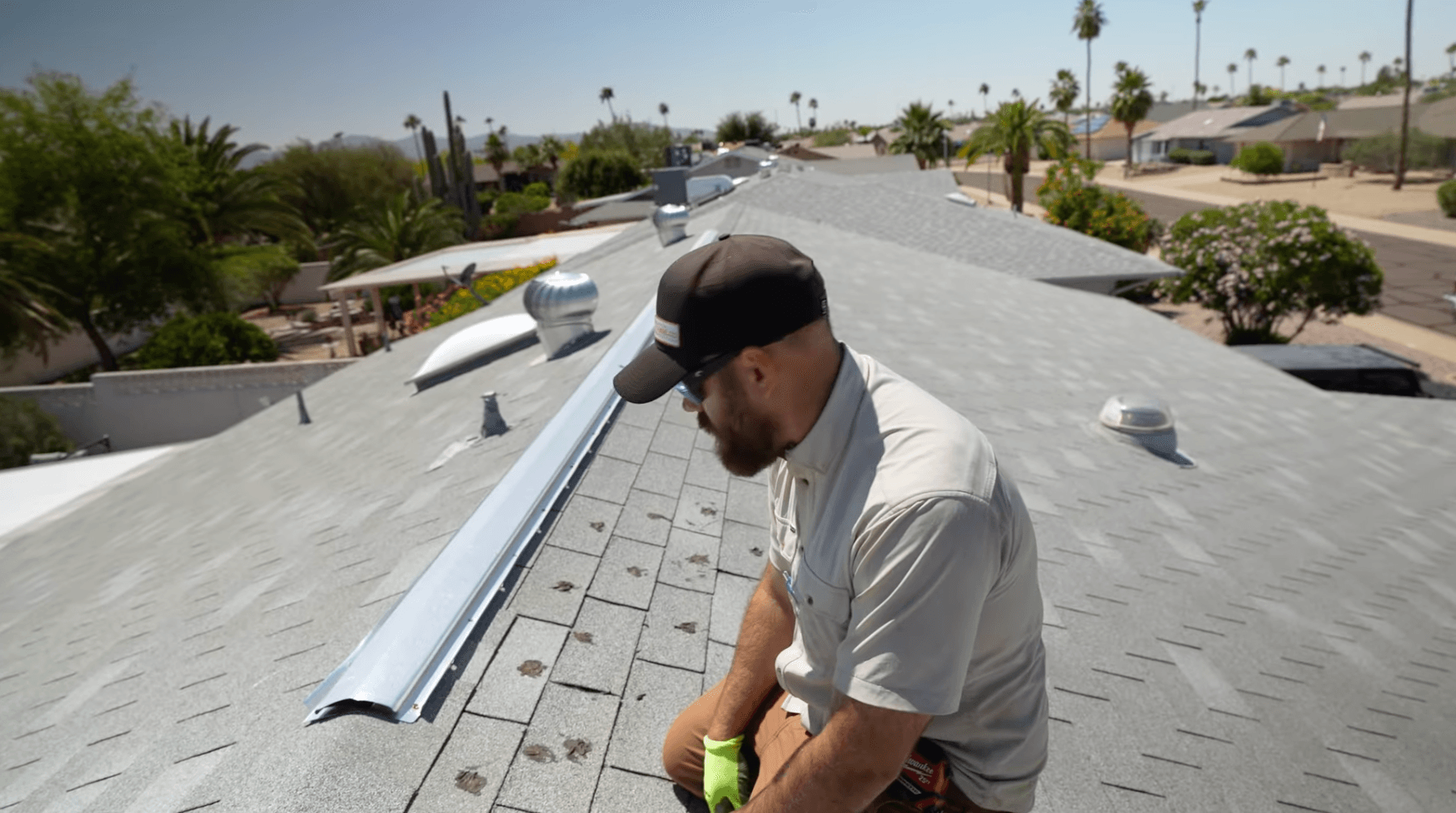
5. Check your roof's age against your neighborhood's pattern. If your home is in a 1970s through early 2000s master-planned community (McCormick Ranch, Scottsdale Ranch, Gainey Ranch, DC Ranch, Grayhawk, Troon) and you haven't had a re-underlayment in the last 20 years, monsoon season is going to find every weak point your underlayment was hiding. See our Scottsdale roof age guide by neighborhood for whether your home is in the replacement window right now.
6. Schedule a pre-monsoon paid inspection if your roof is past 15 years. This is the move that pays back the fastest for older homes. A $150 to $275 inspection identifies the specific weak points (loose tile, deteriorated ridge mortar, lifted flashing, brittle underlayment at the eaves) that the first major storm will exploit. Fixing $400 of weak points before the storm beats fixing $4,000 of storm damage after.
7. Know your insurance deductible before you need to file. Pull your homeowner's policy. Look at the wind/hail deductible specifically (it's often separate from the standard deductible and can be a percentage of dwelling coverage, not a flat dollar amount). If your wind/hail deductible is $5,000, a $4,200 roof repair after a storm is something you'll be paying out of pocket. The insurance vs cash decision often goes differently than homeowners expect, and the time to think it through is before the storm hits.
What to watch for during a Scottsdale storm
Don't climb on the roof during or immediately after a storm. Wet tile is dangerously slick, and even mild monsoon winds can put you on the ground. From the safety of inside the house:
Listen for impact sounds. Hail strikes are distinctive and you can usually hear them clearly. The duration of audible hail tells you roughly the severity. A 30-second hail event is rare and meaningful. A 5-second hail event is common and usually below claim threshold.
Look out windows for debris movement. What's flying around the yard tells you what may have hit the roof.
Check for interior leaks during the storm. If water is going to make it through the roof, it usually shows up at the ceiling within 15 to 30 minutes of intense rain. Document the location with a photograph; the staining will spread and the source becomes harder to pinpoint after the fact.
Note the time and direction of wind. Most Valley monsoon damage is from west or northwest outflow winds. Knowing the direction helps your roofer (and your insurance adjuster, if it comes to that) understand the load pattern.
The 48 hours after a storm
This is where the most important documentation work happens. We have a detailed Valley-wide post-storm checklist that walks through every specific photo to take and every place to look. See the monsoon storm checklist for the full walkthrough. The short version:
Document everything within 48 hours. Walk the perimeter, photograph the ground for debris, photograph the eaves from below, check the attic for daylight or wet insulation, walk every interior ceiling looking for stains. Get an independent roof inspection before you call your insurance carrier, and then review adjuster meeting prep before the carrier's adjuster shows up. The single most valuable move on any storm claim is having your own roofer on the roof during the adjuster inspection.
If your roof is actively leaking, call any roofer for emergency tarp dispatch immediately. Most Valley contractors (including us) dispatch tarps the same day during monsoon season. Tarp work counts as covered mitigation under almost every homeowner policy.
After the season closes: what to do in late September and October
Monsoon season officially ends September 30, and the weeks right after it are the most useful inspection window of the year in the Valley.
By late September the summer's storm record is complete and dated. Your roof has taken everything the season had, but it hasn't yet been through a winter of additional weathering, so damage still reads clearly as storm damage rather than general wear. Your neighbors' roofs — the best corroboration you have that a specific cell hit your street hard — are still in post-storm condition rather than already repaired. And the seasonal surge in adjuster and contractor scheduling has cleared, so an inspection booked in October actually happens in October.
There's a practical reason to move too: October and November are the best re-roofing weather the Valley gets. Crews work full days, materials behave, and nothing is being rushed ahead of the next cell. A scope approved in October gets built in good conditions. The same scope approved in June gets built in 110-degree heat between storms.
So if any of the following is true, this is the month to get on a roof.
A storm cell clearly hit your area this summer and nobody has been up there since.
A ceiling stain appeared sometime after June, however small it still looks.
You found tile fragments or granule piles in the yard at some point and never followed up on them.
Your roof is past 15 years old and hasn't been inspected in the last two seasons.
If an inspection turns up storm damage, how to file a monsoon roof damage insurance claim in Arizona walks through the entire process from deductible math to collecting recoverable depreciation.
How HailCo handles monsoon season
We dispatch from our Scottsdale yard, which means we can usually get a tarp crew to a Scottsdale, Paradise Valley, Fountain Hills, or North Phoenix property within a few hours of an active-leak call during monsoon season. We don't charge a separate dispatch fee on tarp work for storm-damaged roofs; the tarp cost is folded into the eventual repair.
For non-emergency post-storm inspections, we schedule within 24 to 48 hours during peak monsoon weeks. The earlier you call after a storm, the more useful the documentation is for an insurance claim if it comes to that.
If your roof is past 15 years old and you haven't had a pre-monsoon inspection in the last two years, call us at (480) 582-3122 or request a free estimate on visible damage. Tanner walks the roof, photographs everything, and tells you what's likely to fail in the next storm cycle. Most pre-monsoon repairs are in the $300 to $1,200 range and prevent the $3,000 to $15,000 post-storm scopes we see when small weak points became major leaks. We'd rather catch your roof's weak points in May than be dispatching a tarp crew to your house in July. No high-pressure sales calls, no upsells you don't need. Just a real conversation about your roof and the next storm.
Side-by-side
Scottsdale monsoon exposure by zone
| Zone | Major ZIP codes | Communities | Typical exposure |
|---|---|---|---|
| North Scottsdale | 85255, 85262, 85266 | DC Ranch, Silverleaf, Troon, Desert Mountain, Estancia, Whisper Rock | Highest hail risk and strongest microbursts in the Valley |
| Central Scottsdale | 85250, 85251, 85253, 85258, 85259 | McCormick Ranch, Gainey Ranch, Scottsdale Ranch, Stonegate | Moderate wind and hail; severe events possible |
| West / Central-West | 85254 | Western central Scottsdale | Moderate wind, lower hail than the far north |
| South Scottsdale + Old Town | 85251, 85257 | Old Town, South Scottsdale neighborhoods | Lowest elevation; less hail; older roof stock more vulnerable to wind |
| Paradise Valley (adjacent) | 85253 | Paradise Valley town | Spans every era; exposure varies by specific neighborhood |
| Fountain Hills (adjacent) | 85268 | Fountain Hills | High elevation; exposure similar to North Scottsdale |
Frequently asked
Questions we hear about this.
When does monsoon season start in Scottsdale?+
Arizona's monsoon season is officially declared June 15 through September 30 by the National Weather Service. The active storm window concentrates between July 1 and September 15, with peak activity from mid-July to mid-August. During peak weeks, storm cells form over the Mogollon Rim in the late afternoon, drift southwest, and arrive in the Valley between 5 PM and 8 PM. The first storms of the season (mid-June to early July) are erratic but can produce the largest microburst events of the year in some years.
What Scottsdale ZIP codes see the most storm damage?+
North Scottsdale ZIP codes 85255, 85262, and 85266 see the largest hail events and the strongest microburst winds in the Valley because of the higher elevation and proximity to the Mogollon Rim where most storm cells form. Communities in this zone include DC Ranch, Silverleaf, Troon, Desert Mountain, Estancia, and Whisper Rock. Central Scottsdale (McCormick Ranch, Gainey Ranch, Scottsdale Ranch areas) sees moderate exposure. South Scottsdale and Old Town are at lowest elevation with the least hail risk, though their older 1950s and 1960s roof stock is more vulnerable to wind damage just because of system age.
Should I file an insurance claim after a Scottsdale monsoon storm?+
Not always, and not before you have your own roof inspection done. Roughly 30% of post-storm calls we take in Scottsdale turn out to be no-claim repairs in the $300 to $900 range, and filing an unsupported claim can sometimes count against your loss history even when denied. The right sequence is: document everything within 48 hours of the storm, get an independent roof inspection (we do these within 24 to 48 hours during peak monsoon weeks), and decide based on what's actually damaged versus your wind/hail deductible. See our broader insurance vs cash decision guide and our adjuster meeting prep article for the full decision tree.
How do I prep my Scottsdale roof for monsoon season?+
Seven steps, ideally completed by mid-June: (1) walk your roof perimeter from the ground and photograph anything that looks lifted, exposed, or missing; (2) clear gutters and roof valleys of palm fronds and debris; (3) trim back trees within 10 feet of the roof; (4) tie down or store loose outdoor items that could become projectiles; (5) check your roof's age against your neighborhood's typical replacement window; (6) schedule a paid inspection if your roof is past 15 years; and (7) pull your homeowner's policy and check your wind/hail deductible specifically (it's often separate from your standard deductible and can be a percentage of dwelling coverage, not a flat amount).
Does HailCo dispatch tarp crews during monsoon season?+
Yes, same-day during active monsoon weeks. We dispatch from our Scottsdale yard, so we can usually get a tarp crew to a Scottsdale, Paradise Valley, Fountain Hills, or North Phoenix property within a few hours of an active-leak call. We don't charge a separate dispatch fee on tarp work for storm-damaged roofs; the tarp cost is folded into the eventual repair invoice. Tarp work also counts as covered mitigation under almost every homeowner policy, so it doesn't typically affect your eventual claim outcome. Call (480) 582-3122 if you have an active leak. For non-emergency post-storm inspections we schedule within 24 to 48 hours during peak monsoon weeks.
Next step
Want a pre-monsoon inspection before the next storm cell rolls through?
If your roof is past 15 years old, a $150 to $275 inspection (credited toward any work) identifies the specific weak points the first major monsoon will exploit. We dispatch tarp crews same-day during storm season from our Scottsdale yard.
Services covered in this guide
Ready to act on what you read?
- Storm & Hail DamageWind, hail, and monsoon damage assessment across the Phoenix Valley with photo-documented claim support and adjuster representation.
- Emergency RoofingSame-day emergency roofing in Scottsdale and the Phoenix Valley: tarp, dry-in, and active-leak response 7 days a week.
- Insurance Claim SupportArizona roof insurance claim support: documentation, scope review, adjuster meetings, and supplement handling — included with your HailCo repair.
- Roof RepairTargeted roof repair across the Phoenix Valley — leaks, cracked tile, lifted shingles, and failed flashing found and fixed correctly.
More resources
Keep reading.
- Read →
Cost & Financing
What a tile roof actually costs in Arizona (and what you're really paying for)
Most quotes lump material, labor, underlayment, and tear-off into one number. Here's how to break it apart and compare contractors honestly.
- Read →
Insurance & Storm Damage
The 12-point monsoon checklist every Valley homeowner should run
What to inspect (and what to photograph) within 48 hours of a storm: for your records, your roofer, and if needed, your insurance carrier.
- Read →
Materials & Shingles
Shingle vs. tile vs. foam: which is right for your Arizona home?
A side-by-side comparison from a contractor who installs all three across the Valley every week. No manufacturer marketing.