Insurance & Storm Damage
The 12-point monsoon checklist every Valley homeowner should run
What to inspect (and what to photograph) within 48 hours of a storm: for your records, your roofer, and if needed, your insurance carrier.

TL;DR
The quick version
- Document storm damage within 48 hours: date-stamped photos of every affected slope, plus the gutters and ground debris.
- Don't call your insurance carrier first. Get an independent roof inspection so you know what's actually damaged before scope-of-loss is set.
- Tarp first, repair later. Same-day tarp work counts as covered mitigation under most homeowner policies.
- If you have rooftop solar, photograph panel attachments separately — they're often part of the repair scope.
When a monsoon cell hits the Valley, the difference between a $400 repair and a $25,000 insurance claim is often documentation captured in the first 48 hours. Roof damage from wind and hail accumulates quietly, and by the time water shows up inside, the proof of cause is usually gone.
Reading this near the end of the season? Arizona's monsoon window closes September 30. If a cell came through your area back in July or August and you never documented anything, run this checklist anyway — it is weaker evidence than same-week photographs, but it is far better than arriving at an adjuster meeting with nothing. Then see how to file a monsoon roof damage claim in Arizona for what the rest of the process looks like from here.
This is the checklist we run with our own customers after every significant storm event in their area. Run it yourself before you call anyone. (If you're reading this before the storm and want to prep your roof for monsoon season instead, see our Scottsdale monsoon roof prep guide for the pre-storm version: what to fix before mid-June, what to watch for during a cell, and how the patterns differ across Scottsdale ZIP codes.)
From the ground (safe, no ladder needed)
1. Walk the perimeter of the house. Photograph all four sides at full-house scale. These wide shots establish what the roof looked like immediately after the event.
2. Photograph the ground. Look for shingle granules in flower beds, broken tile fragments on patios, displaced ridge cap pieces. Photograph anywhere you find debris. These prove tile or shingle failure.
3. Check gutter and downspout outlets. Heavy granule loss in gutter discharge is evidence of shingle damage even when the roof field looks intact.
4. Photograph fence damage and downed branches. This is corroborating evidence of wind strength in your specific microclimate, useful when an adjuster asks "was it really that bad here?"
5. Look at neighboring roofs. If three houses on your street have missing tile, your claim becomes easier to support. Photograph their roofs too (with permission if visible from public sidewalk).
From inside the attic (if accessible)
6. Look for new daylight. Any pinholes, gaps, or beams of light visible from inside the attic that weren't there before. Photograph the location relative to a recognizable feature (vent stack, rafter, etc.).
7. Touch insulation for moisture. Damp or wet insulation is a leak indicator. Photograph wet spots before they degrade visibility as they dry.
8. Smell for mustiness. Fresh moisture in the attic has a distinct smell. Note it in writing with a date.
From a safe vantage (ladder, second-story window, or drone)
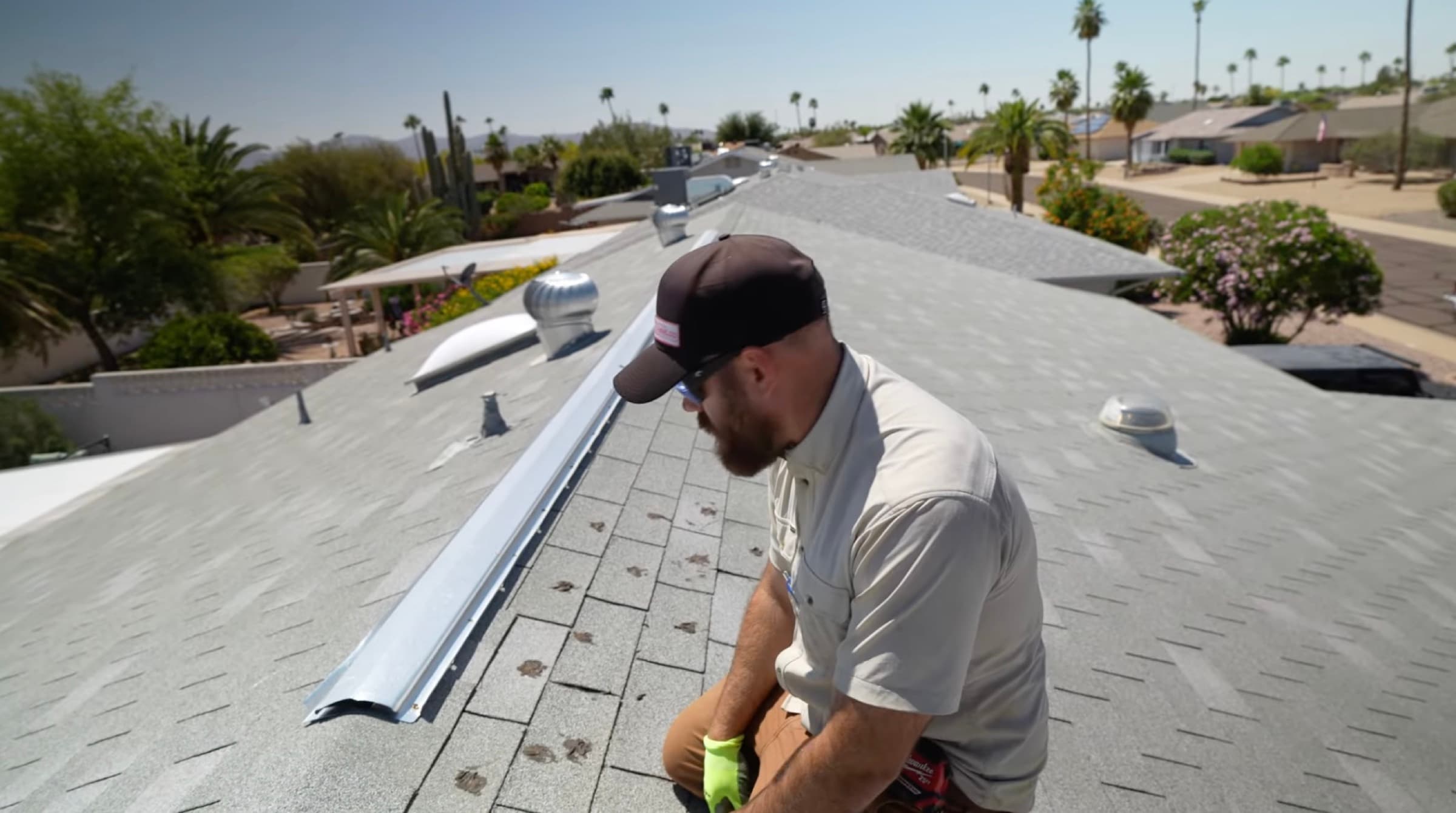
9. Photograph missing or lifted tile. Even one missing field tile is enough to file. Document the location relative to a roof feature (valley, ridge, chimney).
10. Photograph damaged flashing. Lifted, bent, or torn flashing around penetrations is the highest-likelihood leak path post-storm.
11. Photograph cracked tiles in place. Hail strikes leave hairline cracks across the top of concrete and clay tile. Side-light (early morning or late afternoon) makes them easiest to see.
After the photos
12. Write down the date, approximate time of storm, and which direction the wind came from. Most Valley monsoon damage is from west or northwest outflow. The direction matters for the adjuster's wind-load assessment.
What to do with all this
Don't file a claim yet. Call us first (or any roofer you trust) for a free post-storm inspection. Roughly 30% of post-storm calls we take turn out to be no-claim repairs ($300 to $900 range), and filing an unsupported claim can sometimes count against your loss history even when denied.
If we do see claim-worthy damage, the documentation you captured in the first 48 hours becomes the foundation of the scope we file. We meet your adjuster on the roof, walk through findings together, and supplement the scope where the initial adjuster's report misses code-required items.
For the full sequence from that point forward — deductible math, giving notice, why the first check is smaller than the approved scope, and which supplements Arizona adjusters miss most often — see how to file a monsoon roof damage insurance claim in Arizona.
For a free post-storm inspection in Phoenix, Glendale, Mesa, or anywhere else in the Valley, call (480) 582-3122. We typically dispatch within 24 hours of monsoon events.
Side-by-side
What to inspect (and what to photograph) within 48 hours
| Area | What to look for | Photo evidence |
|---|---|---|
| Roof slopes | Cracked or missing tile, lifted ridge cap, exposed underlayment | Wide shot of each slope, close-up of damage |
| Gutters | Granule beds, tile fragments, leaf-and-twig dam | Inside the gutter, looking down |
| Ground debris | Roof material on lawn, in pool, by AC unit | Wide shot with house in frame for context |
| Attic | Daylight visible at penetrations, damp insulation | Photograph with flash, note any wet spots |
| Interior ceilings | Water stains, paint bubbling, drywall sagging | Photo with date stamp visible |
| Solar / satellite | Panel mount displacement, dish angle change | Close-up of mount attachments |
Frequently asked
Questions we hear about this.
What should I do immediately after a monsoon storm hits my Arizona home?+
Document everything within 48 hours. Walk the perimeter and photograph any roof material on the ground, in gutters, or near the pool and AC unit. Check the attic with a flashlight for daylight or wet insulation. Don't climb the roof yourself if it's wet or steep. Schedule a free roof inspection within 2 to 3 days so any damage is documented before your insurance carrier sends an adjuster.
Should I call my insurance company first after a monsoon storm?+
Not first. Get an independent roof inspection from a contractor before you call the carrier. The inspection documents what's actually damaged, which protects you from an adjuster scope that misses items. Many homeowners who call the carrier first end up under-scoped because the initial adjuster pass missed code-upgrade items, tile-color match supplements, or hidden underlayment damage. Inspection first, then claim.
Does Arizona homeowner's insurance cover monsoon roof damage?+
Most policies cover wind, hail, and falling-debris damage from monsoon events. Coverage is usually under the wind/hail or named-perils section. Some carriers exclude cosmetic damage or require an additional wind/hail rider in high-claim areas. Check your declarations page for the wind/hail deductible — it's often separate from your standard deductible and can be a percentage of dwelling coverage rather than a flat dollar amount.
How long do I have to file a monsoon damage claim in Arizona?+
Most Arizona carriers require notice of loss within 30 to 60 days of the storm event, but the sooner the better. Sooner means cleaner documentation, less chance the carrier disputes the storm date, and faster repair scheduling. Even if you can't file immediately, document the damage with date-stamped photos right after the storm. Those photos hold up later even if the formal claim is filed weeks afterward.
What's the most common monsoon roof damage in Phoenix?+
On tile roofs (common in Scottsdale, Gilbert, Chandler): wind-lifted ridge cap and broken individual tiles from microburst gusts. On shingle roofs (older Phoenix and Mesa neighborhoods): lifted shingles and granule loss. On foam roofs (central Phoenix, Sunnyslope): coating tears at parapets and exposed scrim. Hail damage shows as cracking on north-facing tile slopes and dimpling on standing-seam metal accents.
Next step
Just had a monsoon roll through? Get a free inspection before you call the carrier.
We document storm damage with date-stamped photos and an Xactimate-aligned scope before you file the claim. That single step is the highest-leverage move on any Arizona storm claim.
Services covered in this guide
Ready to act on what you read?
- Storm & Hail DamageWind, hail, and monsoon damage assessment across the Phoenix Valley with photo-documented claim support and adjuster representation.
- Insurance Claim SupportArizona roof insurance claim support: documentation, scope review, adjuster meetings, and supplement handling — included with your HailCo repair.
- Emergency RoofingSame-day emergency roofing in Scottsdale and the Phoenix Valley: tarp, dry-in, and active-leak response 7 days a week.
More resources
Keep reading.
- Read →
Cost & Financing
What a tile roof actually costs in Arizona (and what you're really paying for)
Most quotes lump material, labor, underlayment, and tear-off into one number. Here's how to break it apart and compare contractors honestly.
- Read →
Materials & Shingles
Shingle vs. tile vs. foam: which is right for your Arizona home?
A side-by-side comparison from a contractor who installs all three across the Valley every week. No manufacturer marketing.
- Read →
Process & Scheduling
What actually happens during a HailCo roof replacement, day by day
From quote signature to final walk-through: the real schedule, what's noisy when, and what you control.