Materials & Shingles
Shingle vs. tile vs. foam: which is right for your Arizona home?
A side-by-side comparison from a contractor who installs all three across the Valley every week. No manufacturer marketing.
TL;DR
The quick version
- Tile is the right answer for most Valley homes: 50+ year life, fits desert aesthetic, almost always HOA-approved.
- Architectural shingle is cheaper upfront ($10,000-$18,000 typical) but lasts 18 to 25 years vs. tile's 50+.
- Foam is the right answer for flat or low-slope sections only. Maintained with a recoat every 8 to 12 years, it lasts effectively indefinitely.
- Metal is best on hybrid roofs as accents (parapets, dormers) or on modern custom homes with steep architectural slopes.
There's no universally best roof material for Arizona. There's the right material for your specific roof, in your specific neighborhood, with your specific budget. Most homeowners get told the most expensive option is the best one. That's a sales answer, not an engineering answer.
This is the comparison we walk customers through on every replacement estimate. We install all four major Valley materials in-house, so we don't have a financial incentive to push one over another.
Tile (concrete or clay)
Best for: Most pitched Valley homes built in the last 30 years. The dominant Phoenix residential roof for good reason.
Lifespan: 50+ years on the tile itself. Underlayment beneath it: 20 to 25 years.
Installed cost: $14,000 to $32,000 for a typical Valley home.
Strengths: UV-stable, fire-resistant, fits the desert vernacular, takes the heat better than any other material we install.
Weaknesses: Heavy (requires a structurally rated roof deck), breakable underfoot if walked incorrectly. The big one: when "the tile roof fails," it's usually the underlayment beneath it that failed, not the tile. Most homeowners don't realize they can lift the existing tile and re-underlay for a fraction of full replacement cost.
Asphalt shingle (architectural or impact-rated)
Best for: Lower-budget replacements, older homes with structural questions about tile load, and any roof in a hail-prone zip code where the Class 4 impact-rated upgrade pays for itself in insurance premium reduction.
Lifespan: 20 to 25 years in the Valley with proper attic ventilation. Without it, expect 12 to 15.
Installed cost: $10,000 to $22,000 for a typical Valley home.
Strengths: Cheapest installed cost, fastest install (2 to 3 days typical), easiest to repair, widest contractor pool. The Class 4 impact-rated upgrade often discounts homeowner premiums 5 to 20% in hail-prone zips.
Weaknesses: Shorter service life than tile or metal. Heat-aged shingles in poorly-ventilated attics show visible degradation by year 10.
Foam (spray polyurethane)
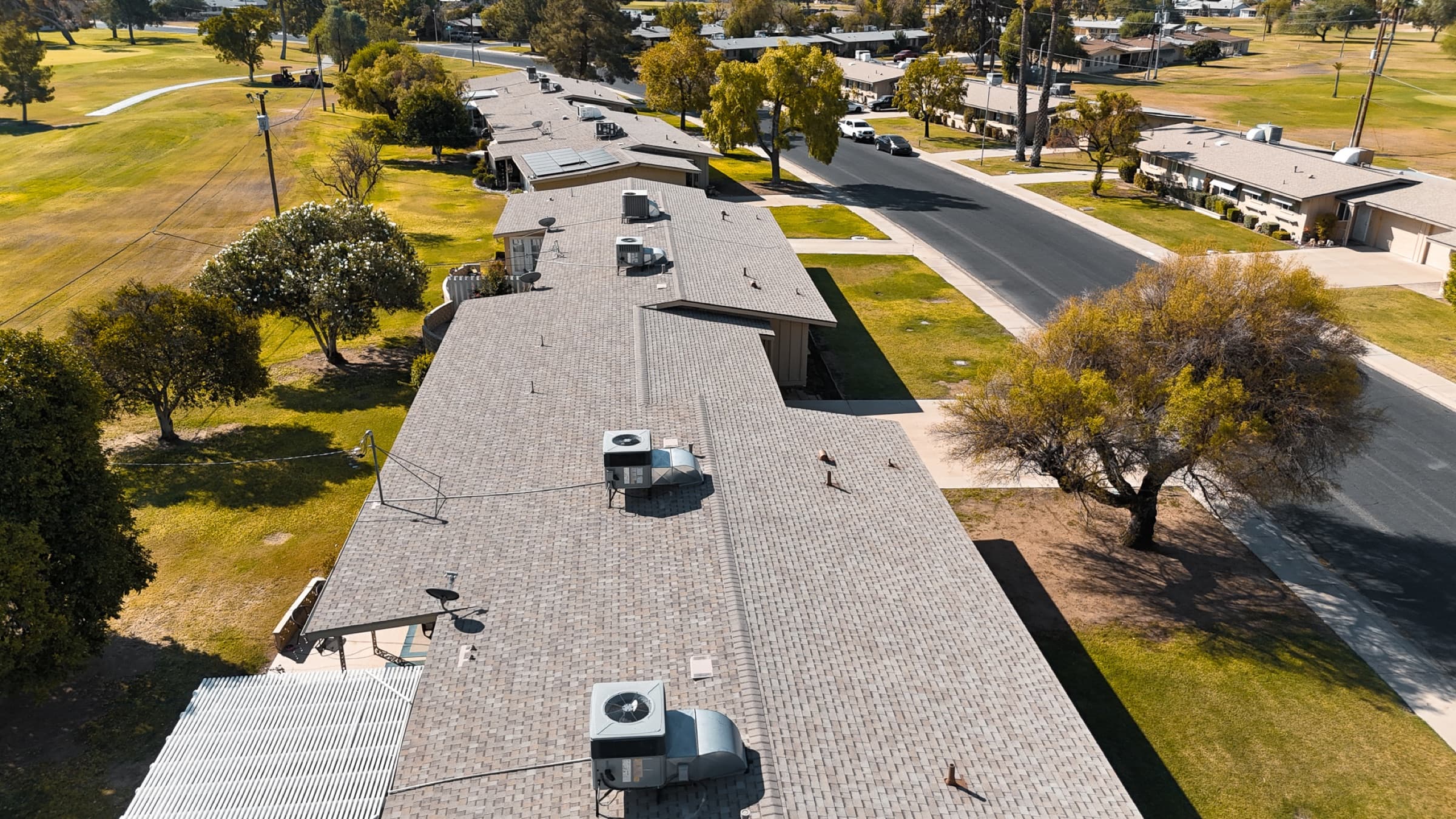
Best for: Flat and low-slope roofs, typical of mid-century Phoenix architecture (Maple Ash, Mitchell Park), modern desert custom homes, and most commercial buildings.
Lifespan: Effectively unlimited if recoated every 8 to 12 years. The original sprayed foam is rarely the failure point.
Installed cost: New install $8,000 to $20,000; recoat $4,000 to $10,000.
Strengths: Seamless (no joints to leak), lightweight, energy efficient (cool-roof coatings drop attic temps measurably), and the recoat economics are remarkable. You essentially never need to replace it, just recoat.
Weaknesses: Wrong material for steep slopes. Requires the recoat discipline. Owners who skip the 10-year recoat cycle eventually face full replacement.
Standing-seam metal
Best for: Modern elevations, hybrid roofs (tile field with metal parapet), and any home where 50-year service life is more valuable than lower upfront cost.
Lifespan: 50+ years easily. Often outlasts the structure.
Installed cost: $22,000 to $48,000 for a typical Valley residential.
Strengths: Longest service life, lowest maintenance, best snow-shed for Northern Arizona (Flagstaff, Prescott), striking modern aesthetic.
Weaknesses: Highest upfront cost. Detail-sensitive. Installation quality determines outcome more than any other material. Some HOAs restrict metal in CC&Rs.
How to decide
In most Valley replacement scenarios, the right answer comes down to:
- Pitched roof, traditional aesthetic, planning to stay in the home 10+ years: Tile (or tile lift-and-set if your existing tile is intact)
- Pitched roof, lower budget, OR hail-prone zip: Architectural shingle (Class 4 in hail zones)
- Flat or low-slope roof: Foam, with a recoat program
- Modern elevation, building for permanence, budget allows: Standing-seam metal
We'll walk through your specific roof and give you the math both ways. Request a free estimate or call (480) 582-3122. Co-owner Tanner Sewell personally handles residential consults.
Side-by-side
Shingle vs. tile vs. foam vs. metal: side-by-side for Valley homes
| Spec | Architectural shingle | Concrete tile | Foam (SPF) | Standing-seam metal |
|---|---|---|---|---|
| Service life | 18–25 yrs | 50+ yrs (tile); 25 yrs (underlayment) | Effectively indefinite with recoats | 40–60 yrs |
| Replacement cost | $10,000–$18,000 | $14,000–$32,000 | $8,000–$20,000 install | $22,000–$48,000 |
| Maintenance | Inspect every 5 yrs | Inspect every 5 yrs, re-underlayment at 25 | Recoat every 8–12 yrs | Inspect every 5 yrs |
| HOA approval | Some allow, many require tile | Almost always approved | Flat sections only | Often requires ARC review |
| Best fit | Cost-conscious tract homes | Default Valley choice | Flat / low-slope sections | Custom homes, accents |
Frequently asked
Questions we hear about this.
Is tile better than shingle for Arizona homes?+
For most Valley homes, yes. Concrete tile lasts 50-plus years versus 18 to 25 for architectural shingle, holds up better in monsoon wind, fits the desert aesthetic, and is required by most master-planned HOAs (McCormick Ranch, DC Ranch, Ocotillo, Power Ranch). The upfront cost is higher ($14,000-$32,000 vs. $10,000-$18,000), but the per-year cost over the roof's life is usually lower with tile.
How long does each Arizona roof material last?+
Architectural shingle lasts 18 to 25 years in Phoenix sun. Concrete and clay tile lasts 50-plus years (with underlayment replacement at the 25-year mark). Spray polyurethane foam (SPF) lasts effectively indefinitely if you stick to an 8-to-12-year recoat schedule; skip a recoat past 12 years and you risk losing the foam itself. Standing-seam metal lasts 40 to 60 years depending on gauge and finish.
Why are foam roofs so common in central Phoenix?+
Foam (spray polyurethane foam, or SPF) is purpose-built for flat and low-slope roofs, which dominate central Phoenix, North Central, and Sunnyslope. The mid-century and modern architectural styles in those neighborhoods often have flat-section roofs that need a seamless waterproof membrane. Foam delivers that, and with a cool-roof coating refreshed every 8 to 12 years, the system performs effectively indefinitely.
Can I mix roof materials on one Arizona home?+
Yes. Hybrid roofs combining tile field with foam parapets and standing-seam metal accents are common on modern custom homes in East Mesa, Higley Estates, and parts of North Scottsdale. Each material does what it's best at on the right slope: tile on the steep ornamental slopes, foam on flat parapets, metal on architectural feature areas. Requires a contractor who handles all three materials in-house — most Valley contractors specialize in one.
What's the cheapest roof I can put on an Arizona home?+
Architectural shingle is the cheapest upfront, $10,000 to $18,000 for most Valley homes. But cheapest upfront isn't always cheapest over time. On a 30-year horizon, you'd replace shingle twice ($20,000-$36,000 total) versus once for tile ($14,000-$32,000). If your home is in an HOA that requires tile, shingle isn't an option regardless of cost.
Next step
Not sure which material is right for your home?
We install all four materials in-house across the Phoenix Valley. Free inspection and an honest recommendation based on your specific roof, your HOA's rules, and your budget.
Services covered in this guide
Ready to act on what you read?
- Tile RoofingScottsdale tile roofing specialist: concrete and clay tile installation, repair, and lift-and-set re-underlayment across the Phoenix Valley.
- Shingle RoofingShingle roofing in Scottsdale & Phoenix from GAF and Owens Corning — architectural and Class 4 impact-rated for hail-prone Valley zip codes.
- Foam RoofingSpray foam (SPF) roofing in Scottsdale and Phoenix for flat residential and commercial roofs — new install and recoat service.
- Metal RoofingStanding-seam metal roofing in Scottsdale and the Phoenix Valley for modern homes, parapet accents, and outbuildings.
More resources
Keep reading.
- Read →
Cost & Financing
What a tile roof actually costs in Arizona (and what you're really paying for)
Most quotes lump material, labor, underlayment, and tear-off into one number. Here's how to break it apart and compare contractors honestly.
- Read →
Insurance & Storm Damage
The 12-point monsoon checklist every Valley homeowner should run
What to inspect (and what to photograph) within 48 hours of a storm: for your records, your roofer, and if needed, your insurance carrier.
- Read →
Process & Scheduling
What actually happens during a HailCo roof replacement, day by day
From quote signature to final walk-through: the real schedule, what's noisy when, and what you control.